
Level Layout Types
An expandable system for defining and running different types of Rogue Point Level Layouts, each with distinct behaviour and gameplay.
- Role: Programmer
- Discipline: Code (Systems)
- Engine: Unreal

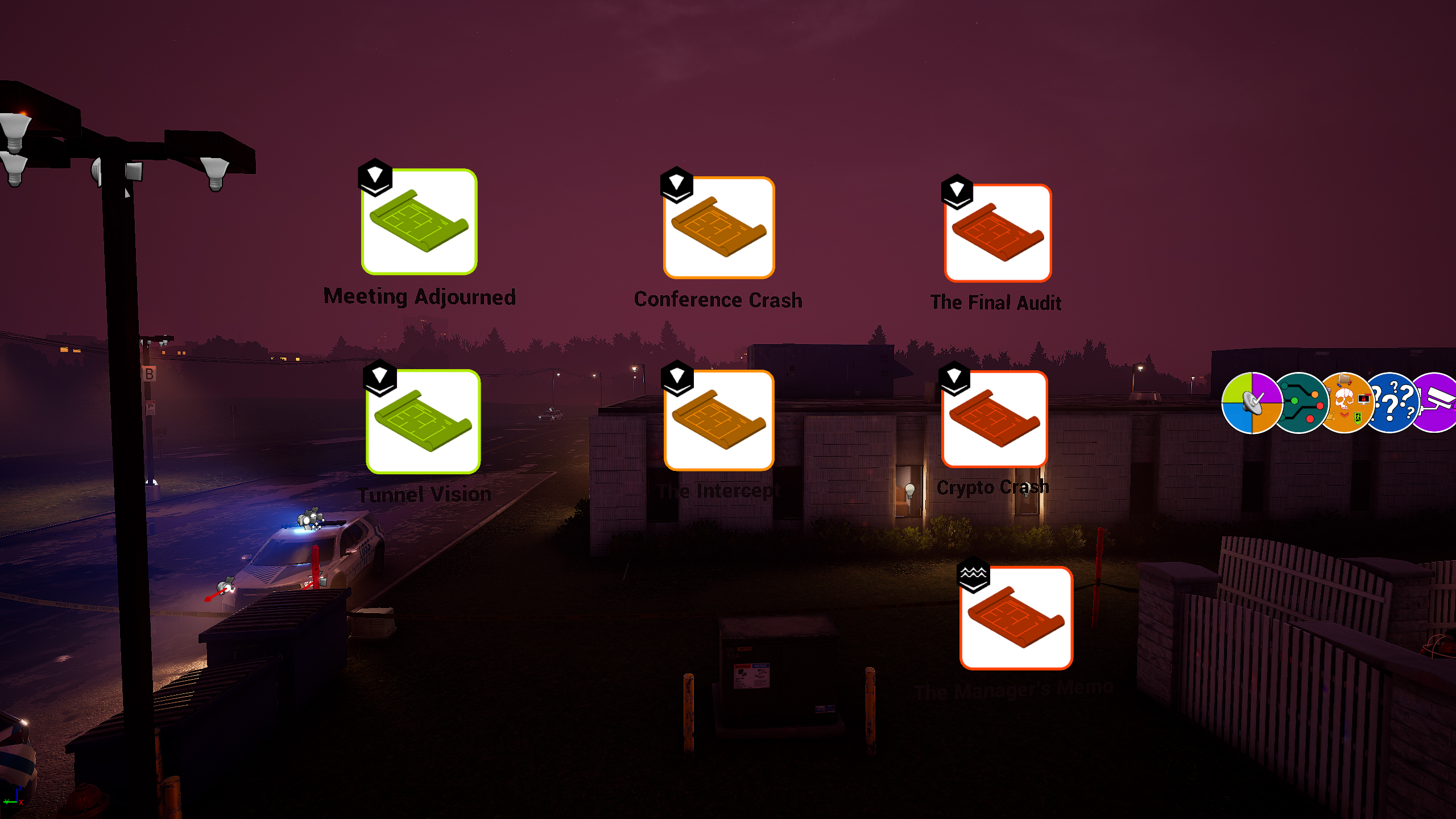
As we approached Rogue Point’s Early Access release, we found that the existing Level Layout system wasn’t doing enough to establish variety through full campaign runs. To address this, we introduced new Level Layout Types: “Strike” and “Raid” missions that played fundamentally differently from standard layouts.
My initial prototype was messy. I extended the existing Level Layout actor by adding more variables, which led to logic for different layout types being spread throughout the codebase. This created issues where bugs in one layout type could affect others. Despite this, the prototype proved that the concept worked well, so we committed to a proper refactor.
Object-Oriented Design
To formalise the system, I rebuilt the Level Layout actor around a clean object-oriented structure. The base class contains all shared data and behaviour, while each Level Layout Type is implemented as a derived class with its own specific or overridden behaviour. This allowed different layouts to behave independently without affecting one another.
I also reworked how randomisation was handled. Instead of the Randomization Manager driving all logic as before, each Level Layout became responsible for randomising itself and reporting the results back to the Manager. This made the system far more flexible and reduced the amount of bespoke code required for new layouts.
A key part of this design was defining a shared randomisation flow in the base class, which calls a series of virtual functions:
RandomizeStartAreas()RandomizeExtractionAreas()RandomizeObjectives()
Derived classes can override only the parts they need, allowing new layout types to stay lightweight and easy to reason about. This made it straightforward for coders and designers to see how each layout type differed: simply by looking at what had been added or overridden.
Here is the base class, showing its overridable structure:
UCLASS(Abstract)
class TANGO_API ATangoLevelLayout : public AActor
{
public:
  ATangoLevelLayout();

  /** Called on all when the Level Layout is chosen. Allows clients to do reliable setup that couldn't be replicated otherwise. */
  virtual void LayoutChosen();

  virtual FManagerPassResults RandomizeStartAreas(const FRandomStream& InStream, const FRandomizationParams& InParams);
  virtual FManagerPassResults RandomizeExtractionAreas(const FRandomStream& InStream, const FRandomizationParams& InParams);
  virtual FManagerPassResults RandomizeObjectives(const FRandomStream& InStream, const FRandomizationParams& InParams,
    ATangoObjectiveManager* InObjectiveManager);
  virtual FManagerPassResults RandomizeCustomObjectives(const FRandomStream& InStream, const FRandomizationParams& InParams,
    UTangoMissionComponent* InMissionComponent);
  virtual FManagerPassResults RandomizeSquads(const FRandomStream& InStream, const FRandomizationParams& InParams,
    const TArray<ATangoLocalManager*>& InObjectiveLocalManagers);
  virtual FManagerPassResults RandomizeStashRooms(const FRandomStream& InStream, const FRandomizationParams& InParams);

  virtual FTangoMissionLayoutData GetMissionLayoutData() const;

  virtual float GetMissionTimer(const ETangoDifficultyMode InDifficulty) const;
And here is a derived Raid Layout class. This is the full header!
UCLASS(Blueprintable, ClassGroup=("Level Layouts"))
class TANGO_API ATangoRaidLevelLayout : public ATangoLevelLayout
{
  GENERATED_BODY()

public:
  ATangoRaidLevelLayout();

  virtual FManagerPassResults RandomizeObjectives(const FRandomStream& InStream, const FRandomizationParams& InParams,
    ATangoObjectiveManager* InObjectiveManager) override;

  virtual FManagerPassResults RandomizeCustomObjectives(const FRandomStream& InStream,
                                                        const FRandomizationParams& InParams,
                                                        UTangoMissionComponent* InMissionComponent) override;

  FText GetDescriptionFromWaves() const;

  /**
  * Gets the Level's valid list of Squad Role names from the Merc Manager.
  * @return                Names of all Squad Roles.
  */
  UFUNCTION(CallInEditor)
  TArray<FName> GetSquadRoles();

  /** Internal helper reference to the Merc Manager. */
  UPROPERTY()
  ATangoMercManager* MercManager = nullptr;

  /** If the Layout is a Raid Layout, this is the structure it will use for its waves. */
  UPROPERTY(EditInstanceOnly, BlueprintReadOnly, Category = "Objectives", Meta = (TitleProperty = "Type"))
  TArray<FRaidWave> Waves = {
    FRaidWave(15.f, ERaidWaveType::MercWave), FRaidWave(ERaidWaveType::MercWave),
    FRaidWave(ERaidWaveType::CustomObjective), FRaidWave(ERaidWaveType::MercWave)
  };

};
Runtime Gameplay Tracking
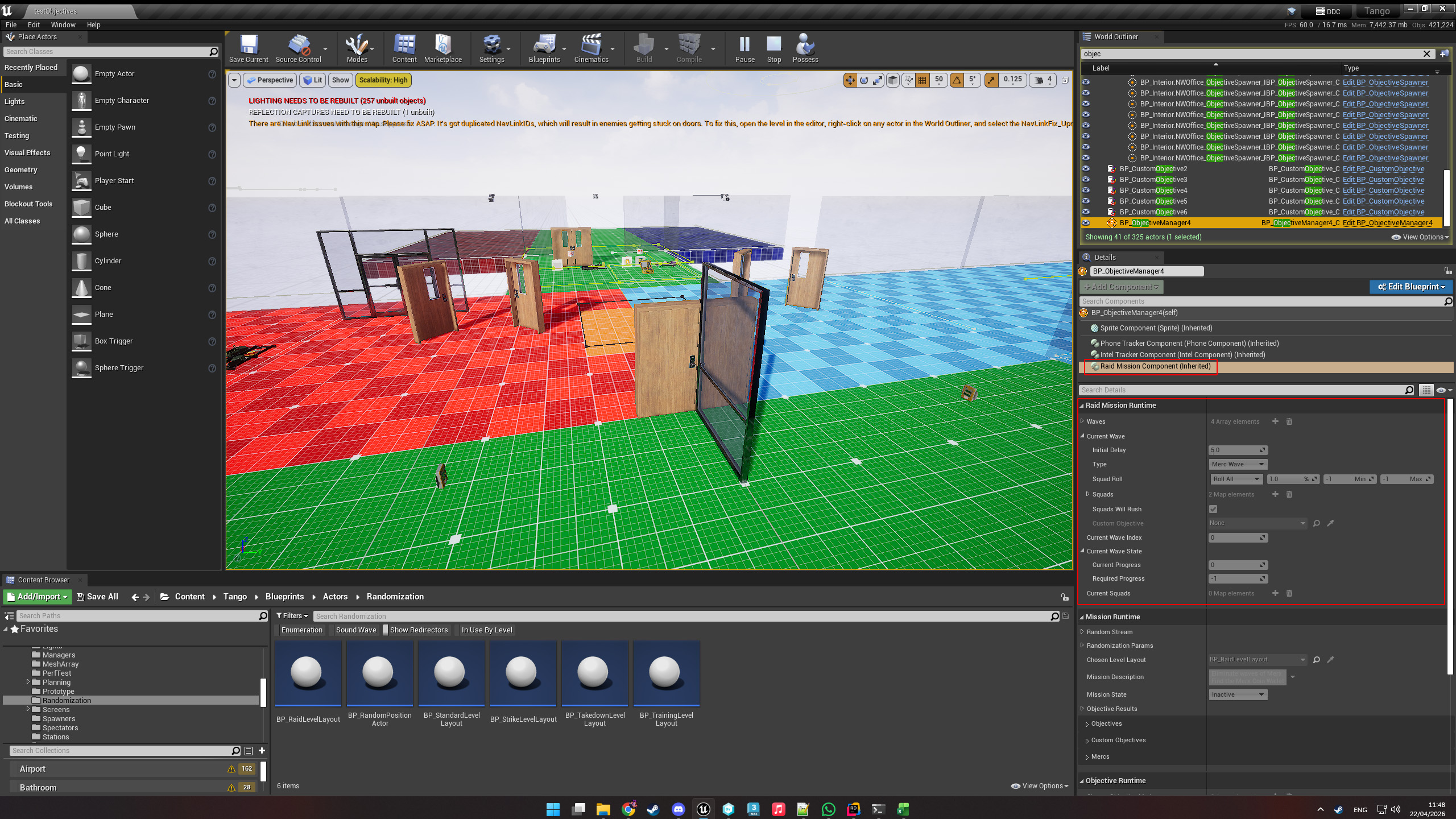
Beyond randomisation, the game also needed to track mission progress for each layout type. To handle this, I separated static level data (Level Layouts) from runtime state by introducing Mission Components to the Objective Manager. Each layout type was given a corresponding Mission Component class responsible for tracking progress and updating the UI.
At runtime, the Objective Manager simply selects the correct component based on the chosen layout. This approach simplified replication significantly: clients only need a reference to the active Mission Component to correctly display mission state and use the correct HUD layout.
Extensibility
One of the biggest advantages of this system is how easy it is to extend. Adding a new layout type only requires:
- A new Level Layout subclass
- A corresponding Mission Component subclass
From there, behaviour can be customised by overriding only the necessary parts. This made prototyping new mission types fast and low-risk, and also opened the door for future expansion.
I’m particularly proud of this system as it represents a clean refactor that incorporated lessons from both design and engineering. It made the game more flexible, more maintainable, and significantly easier to iterate on.